Why Is the Water Green?
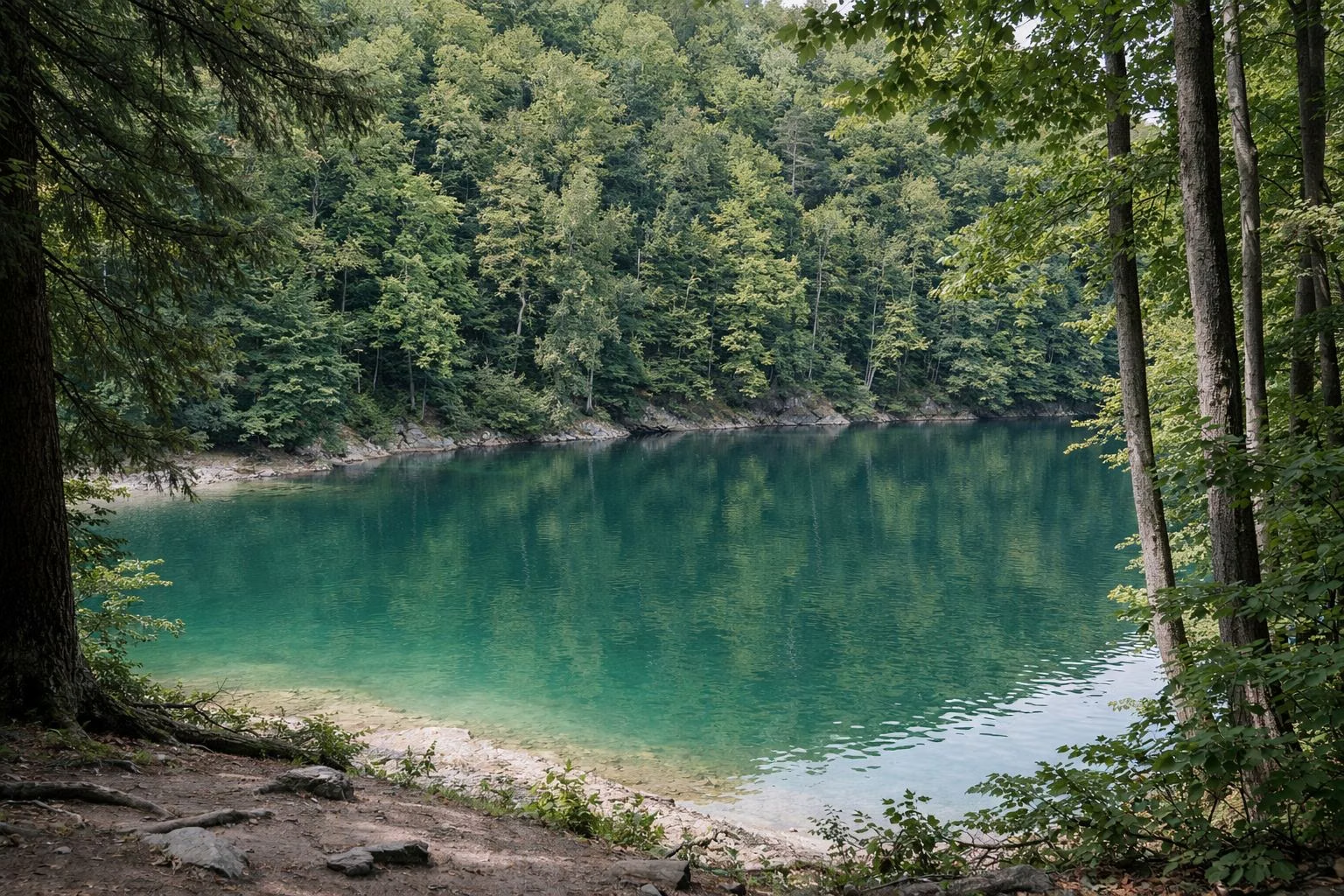
Green Lake looks green because of calcium carbonate. The New York Natural Heritage Program, citing the state Department of Environmental Conservation, says high levels of calcium carbonate in the water reflect green light, which gives the lake its colour, and that the colour does not come from algae or phytoplankton, the usual reason a lake turns green. Green Lake and Round Lake at Green Lakes State Park in Fayetteville are also meromictic lakes: their surface and bottom waters never fully mix.
The Lakes at a Glance
What Gives Green Lake Its Colour
Most lakes that look green get that way from life in the water: blooms of algae or phytoplankton. Green Lake is the other kind. The Natural Heritage Program's guide to meromictic lakes says the lake got its name from its unusual colour, which comes from high levels of calcium carbonate rather than from algae, and that calcium carbonate reflects the green part of the light.
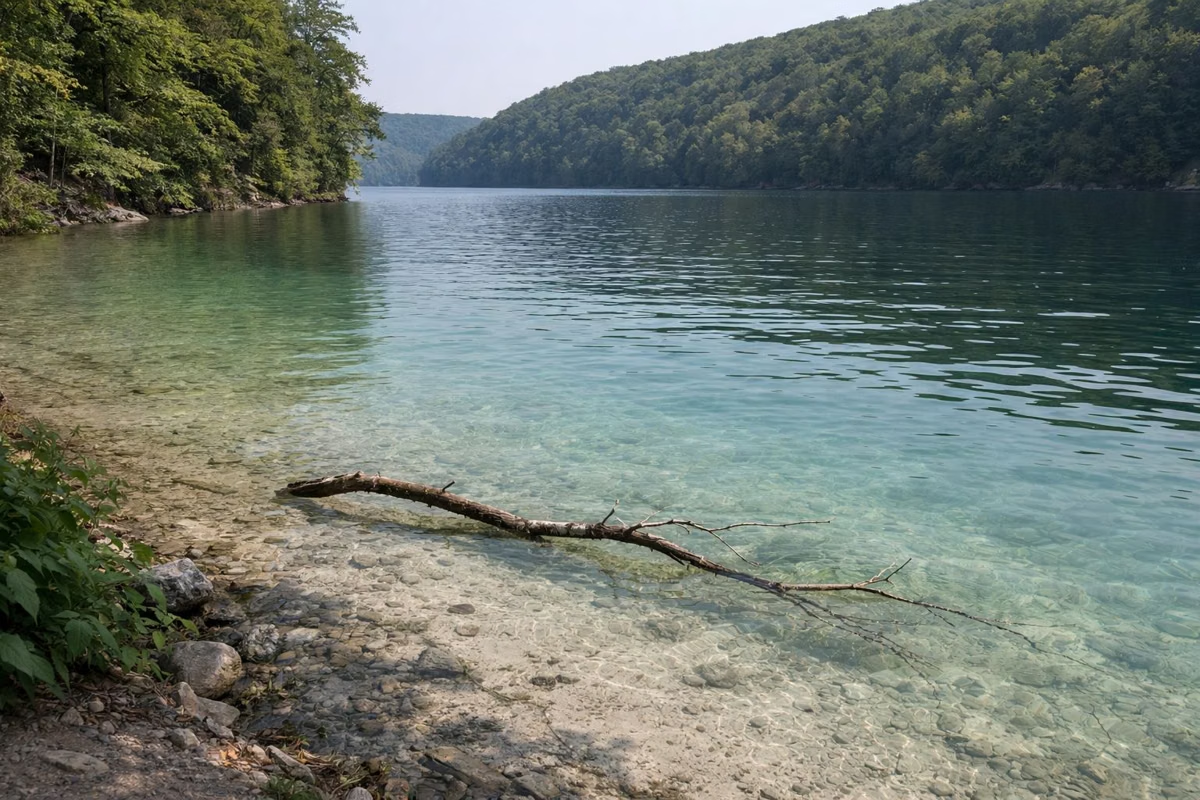
On a sunny summer day the water near the shore looks pale and milky over the light bottom, then shifts to a deeper blue-green farther out. The colour changes with the light, so a grey morning and a bright afternoon can look like two different lakes. The best spots to see it are the benches along the Green Lake Trail, which follows the whole shoreline.
What Is a Meromictic Lake?
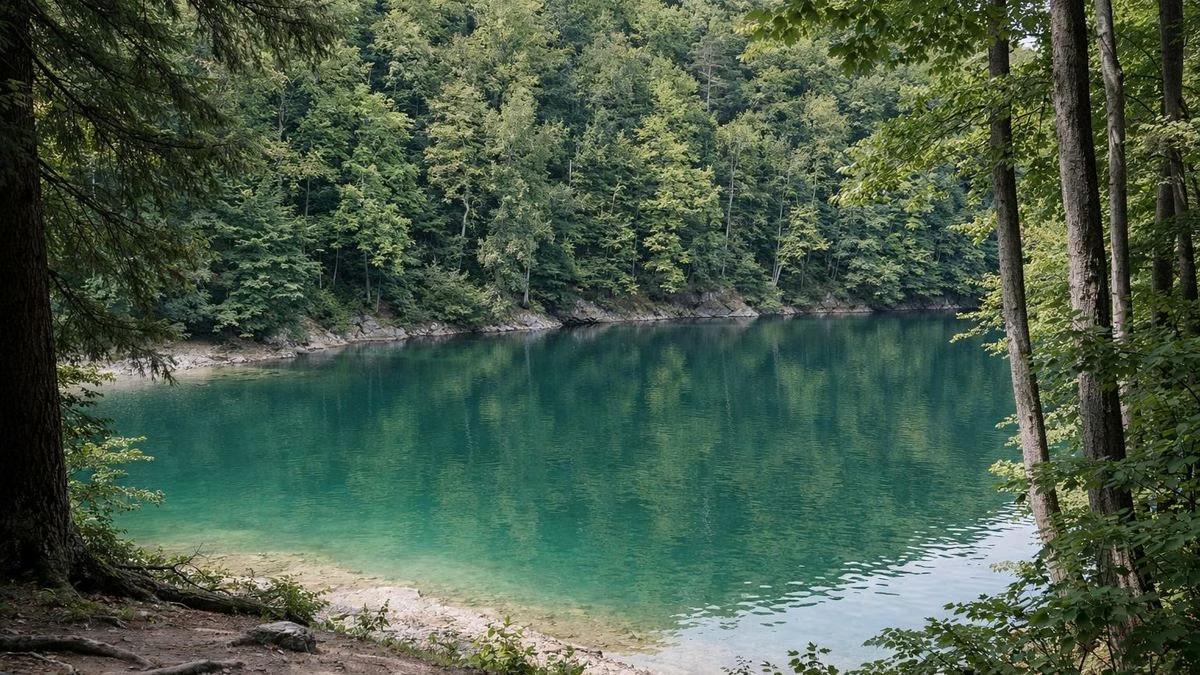
A meromictic lake is one whose top and bottom waters do not mix. Most lakes in New York turn over twice a year: in spring and fall the whole lake reaches one temperature and the wind stirs it from top to bottom. A meromictic lake skips that. NYS Parks puts it simply on its park page: there is "no fall and spring mixing of surface and bottom waters."
The State Parks blog explains why. A meromictic lake is very deep for its surface area, so the wind cannot stir it all the way down. Round Lake is a good example: it is over 163 feet deep and only about 700 feet across. The Natural Heritage Program adds that sheltering trees and steep basin walls help keep the water still.
What Happens in the Deep Water
Because the bottom water never comes back up to the air, it has no oxygen. The State Parks blog says the lower layers also collect dissolved salts, which make that water heavier, so it stays on the bottom. Very little can live there. The few fish in the lakes stay in the top layer, where there is oxygen; snails, zooplankton and phytoplankton are the more common life.
The exception is bacteria. Deep in Green Lake lives a purple sulfur bacterium. A water sample pulled up from that layer comes up purple-pink and smells like rotten eggs, according to the State Parks blog, which credits researchers at SUNY College of Environmental Science and Forestry for studying it.
Why Scientists Care
NYS Parks says lakes like these "have a high potential for evidence of ancient plant and animal life," because layers on the bottom are left undisturbed. Meromictic lakes are rare. The Natural Heritage Program counts probably fewer than 20 in all of New York and calls Green Lake the best-known example. The National Park Service describes Round Lake as one of 11 meromictic lakes reported in the United States.
Green Lake vs Round Lake
Both lakes are meromictic. Round Lake, the smaller one to the south-west, is a National Natural Landmark, designated in 1973 together with the old-growth forest around it. The State Parks blog says Green Lake was left out of the landmark because of its heavier use and less natural surroundings: the beach, boathouse and main picnic areas are all on Green Lake. See Round Lake for the landmark, and the old-growth forest for the trees.
How the Lakes Formed
NYS Parks calls them two glacial lakes and describes the park's grade-four school program as showing how glaciers carved the landscape and "created our unique lakes." The Natural Heritage Program says meromictic lakes in New York are found where glacial waterfalls scoured deep plunge pools into the bedrock, leaving steep sides that keep the wind from mixing the water. Clark Reservation State Park, in Jamesville, has another glacial plunge-basin lake whose surface and bottom waters do not mix.
Why You Can't Bring Your Own Boat
The lakes' chemistry is the reason for one of the park's firmest rules. NYS Parks says that "due to the sensitive nature of both Green and Round Lakes, no outside/private boats, kayaks, or canoes are allowed." You can still get out on Green Lake in a rented kayak or rowboat in summer; see boat rentals. Fishing is allowed on Green Lake only, outside the swimming area, and never on Round Lake. See fishing.
See It for Yourself
The Environmental Education Center, in a former 1940s boathouse on Green Lake, has exhibits on how the park's meromictic lakes formed and how they work, plus a large topographic map of the park. See nature center for hours. Then walk the Green Lake Trail: it is flat, foot traffic only, and stays beside the water the whole way.
Why Is the Water Green? FAQ
Why is Green Lake green?
Calcium carbonate. The New York Natural Heritage Program, citing DEC, says high levels of calcium carbonate in the water reflect green light. The colour is not caused by algae or phytoplankton.
What does meromictic mean?
A meromictic lake's surface and bottom waters never fully mix. Green and Round Lakes skip the spring and fall turnover that stirs most New York lakes, so their deep water stays still, salty and without oxygen.
How deep is Round Lake?
NYS Parks' blog gives Round Lake as over 163 feet deep and about 700 feet across. That depth for such a small surface is why it never mixes.
Is the water at Green Lakes safe to swim in?
Yes, at the guarded beach on Green Lake in season. NYS Parks posts beach water quality results on its website. Swimming is allowed only at the beach.
Can you see the bottom of Green Lake?
Near the shore the water is clear over a pale bottom. Farther out, the lake drops to depths where no light reaches, and the deep water has no oxygen.